FACES BETWEEN CHARM AND HARM, GALLERY ATELIER FUR ANGEWANDTE UND BILDENDE KUNST VIENNA
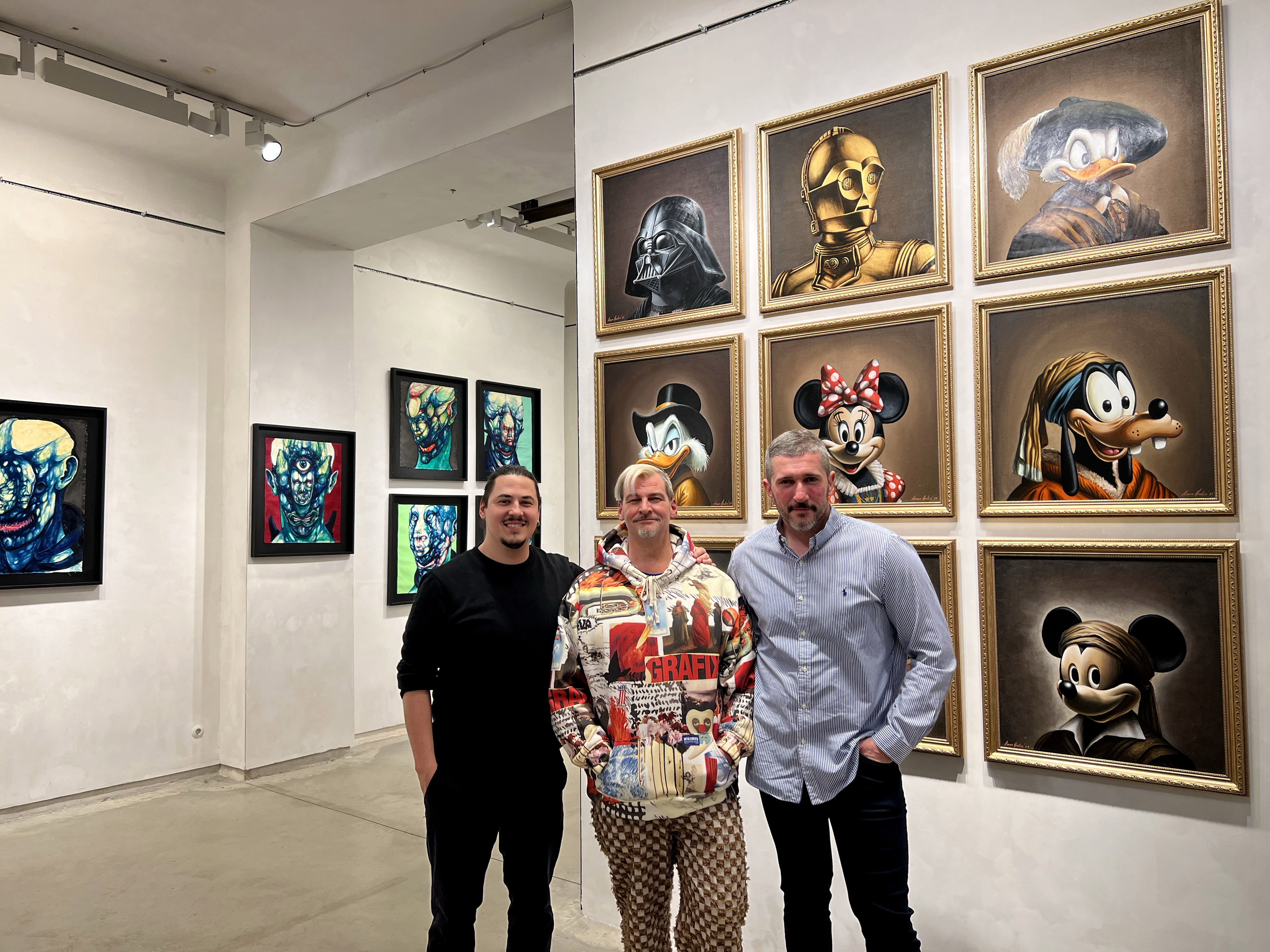
A joint exhibition by Bosnian-Herzegovinian artists Denis Haračić and Amer Hadžić, titled Faces Between Charm and Harm, opened in Vienna at the Atelier für angewandte und bildende Kunst, presenting a total of 37 artworks. The exhibition brings together and contrasts the distinct artistic languages of the two artists, who explore related humanistic themes from their individual perspectives, questioning human nature, identity, and the social conditions that shape contemporary experience. The exhibition was realised in collaboration with Splitart, an art promotion company.
Haračić’s artistic practice focuses on the inner world of the individual, shaped by mass media, social pressures, and constant exposure to information. Through distorted human figures, unsettling imagery, and a visual language that combines the grotesque with the familiar, he explores questions of identity, alienation, and the boundaries of humanity. His figures, which at first glance appear almost dehumanised, reflect deeper psychological and social contradictions, revealing the tension between consciousness and instinct, vulnerability and survival. These themes extend beyond the local context, reflecting a broader global society in which individuals increasingly confront a loss of orientation, empathy, and deeper meaning.
Hadžić, by contrast, employs sarcasm, irony, and elements of popular culture to critically examine contemporary society and the absurdities of technological progress. Drawing on the symbolism of traditional Bosnian houses and recognisable urban landscapes, he incorporates references to popular culture and everyday life into his work. Characters such as Popeye and Mickey Mouse, alongside satirical inscriptions and graffiti, create a visual language that merges nostalgia with social critique. Through these contrasts, Hadžić explores the relationship between cultural memory, collective identity, and contemporary social change, transforming familiar spaces into sites of subtle yet incisive reflection on reality.
The essence of Faces Between Charm and Harm lies in the encounter between these two approaches. While Hadžić explores how human presence becomes inscribed in space and culture through symbols and traces of everyday life, Haračić turns towards the human body and psyche, revealing the inner tensions and contradictions that shape the individual. Their works establish a dialogue between the external world and inner experience, between that which attracts us and that which provokes unease.
The exhibition’s title points to the fragile boundary between charm and harm, attraction and repulsion, the familiar and the unsettling. Rather than offering definitive answers, the artists confront viewers with their own assumptions about human nature, opening a space for reflection on how perceptions, prejudices, and relationships with others are formed. Faces Between Charm and Harm thus becomes a shared inquiry into humanity in an era marked by social divisions, rapid change, and an increasingly complex relationship between the individual and the world around them.


